

Rotation of Consciousness in Yoga Nidra
There is a well-recognised and fascinating relationship between the traditional Nyasa / Rotation of Consciousness in Yoga Nidra and the cortical homunculus in modern neuroscience. The sensory-motor homunculus (discovered by Wilder Penfield) is a map in the brain’s cortex where different body parts are represented according to the density of sensory and motor nerves, not physical size. Hands, lips, face, tongue, and feet have disproportionately large areas. The ancient yogic practice of Nyasa / Rotation of Consciousness appears to be an intuitive, experiential mapping of what modern neuroscience later identified as the somatotopic (homunculus) organisation of the brain. By moving awareness through the body in this ordered way, Yoga Nidra effectively “lights up and then releases” specific areas of the sensory and motor cortex, facilitating profound physical relaxation, nervous system down-regulation, and expanded states of awareness.
This is a beautiful example of how ancient yogic technology aligns with modern neuroscience.
In classical Yoga Nidra (particularly the Satyananda and Bihar School traditions), the Rotation of Consciousness (also called Nyasa) involves systematically moving awareness through different parts of the body in a specific order, usually right side, left side, front, back, and major internal organs. The traditional sequence follows the somatotopic organisation of the brain quite closely, mirroring the sequence along the motor and somatosensory cortex.
By systematically naming and bringing awareness to each body part, the practice is believed to stimulate, then relax, the corresponding area in the brain’s homunculus map. This creates a kind of “deactivation” or sensory withdrawal (pratyahara), helping the brain move from active beta waves into alpha and theta states.
Many Yoga Nidra teachers and researchers explicitly link the Rotation of Consciousness to the homunculus, suggesting that the practice systematically calms the sensory-motor cortex, which in turn supports deep nervous system relaxation and access to subtler states of consciousness.
Somatotopic organisation is the way the brain maintains a map-like representation of the body across its surface. The body is mapped onto the brain in a spatially organised way, so that neighbouring regions of the body are represented in neighbouring regions of the brain.
The most famous example is the sensory and motor homunculus, the distorted little figure mapped across the surface of the cortex, with enormous hands, lips, and tongue, and relatively small trunk and legs. The distortion reflects the density of nerve endings and the precision of motor control required, the hands and face get disproportionately large areas of cortex because they are so richly innervated and so finely controlled.
This mapping exists across several areas of the brain:
The somatosensory cortex (postcentral gyrus) maps incoming sensory information like touch, pressure, temperature, pain, and proprioception, from each part of the body to a corresponding patch of cortex.
The motor cortex (precentral gyrus) maps outgoing motor commands in the same way, stimulating different points along it produces movement in different and predictable parts of the body.
The cerebellum maintains its own somatotopic map for the coordination of movement.
The somatosensory cortex, the motor cortex, and the cerebellum are all expressions of the Ayurvedic concept of Majja Dhatu, the nervous system receiving and transmitting the felt sense of the body to itself.
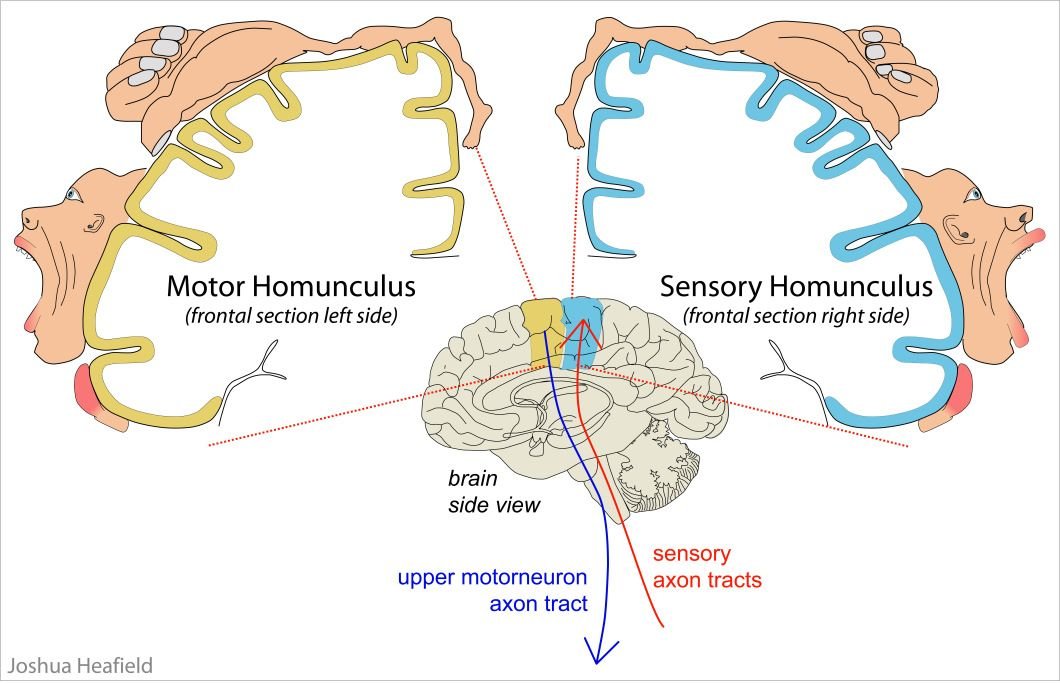
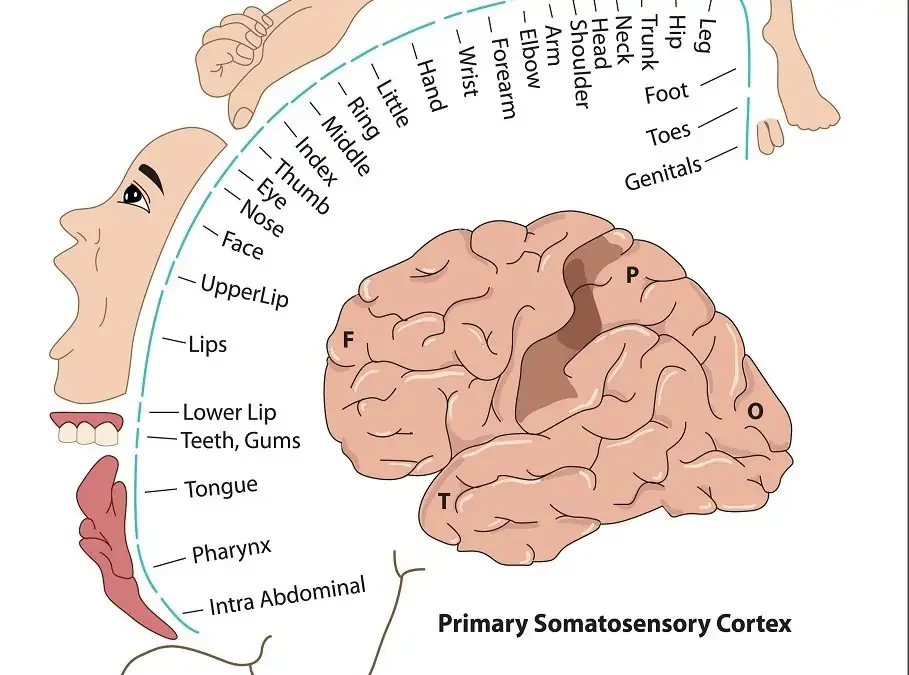
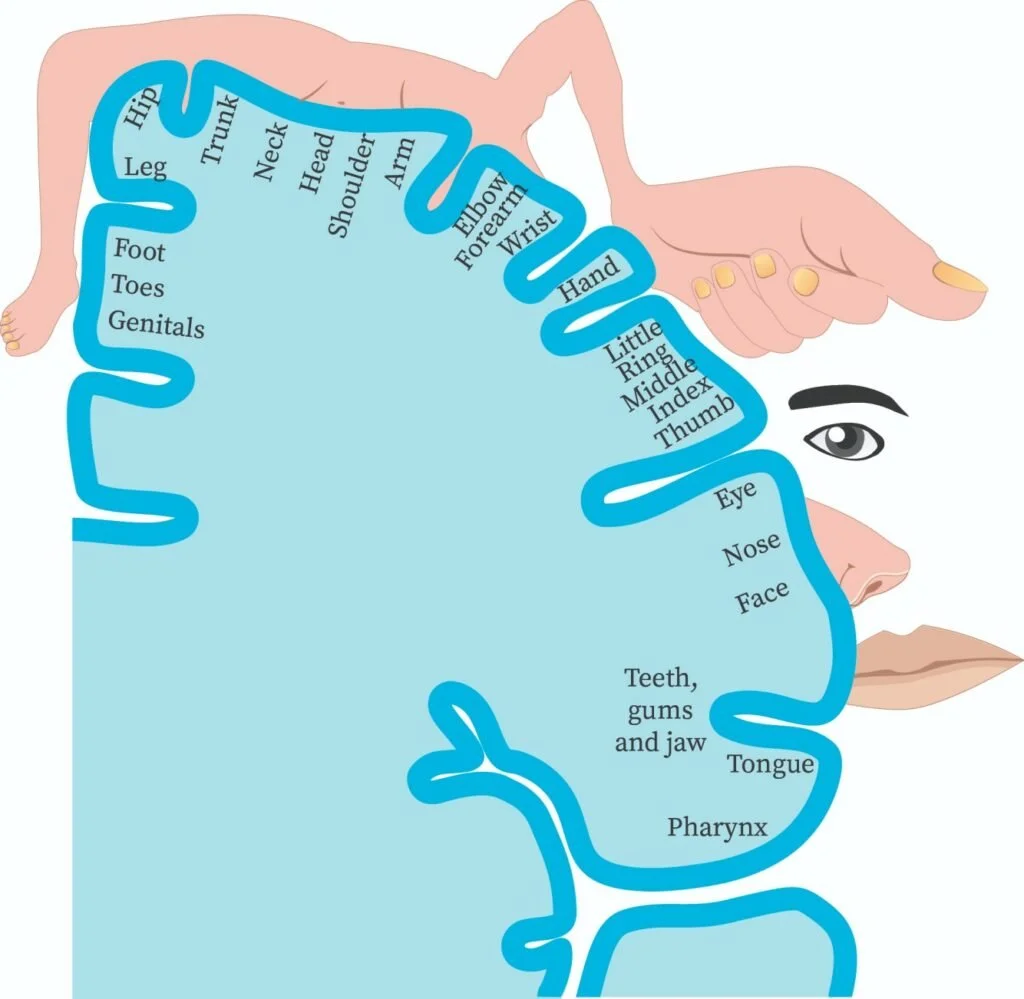
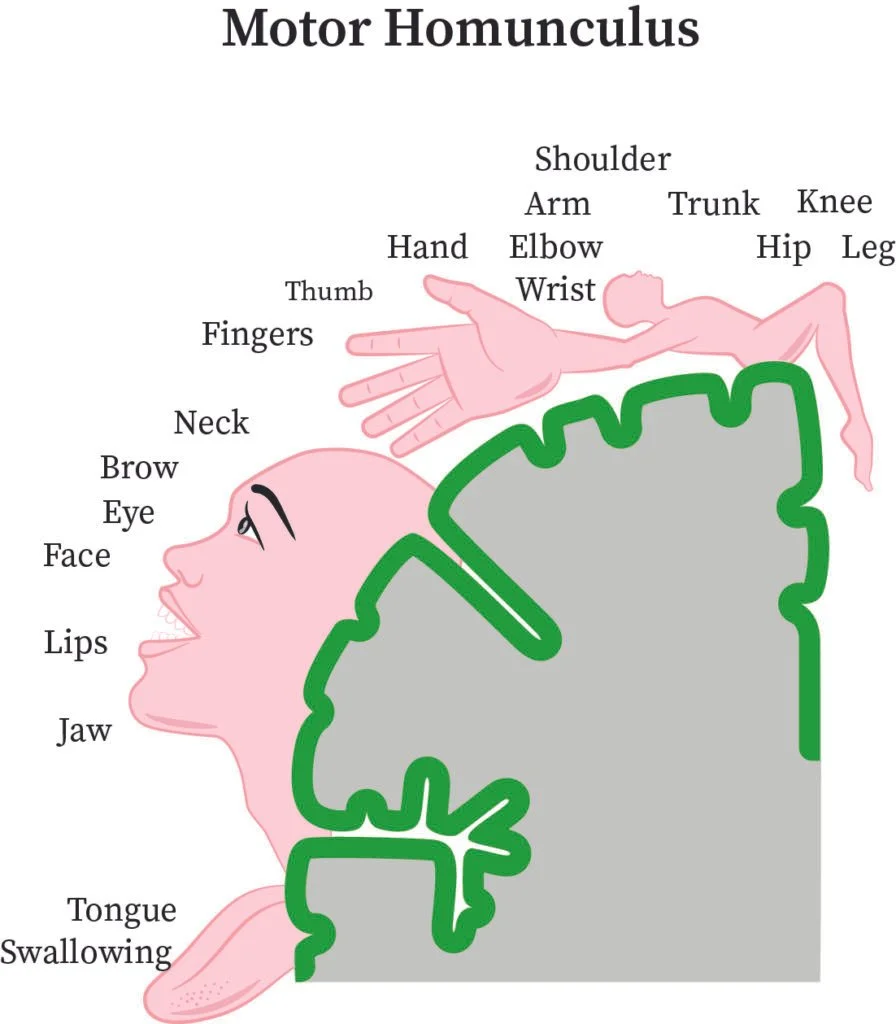
The traditional rotation of consciousness in a yoga nidra practice, is a sequential activation of the somatosensory cortex, moving along its map in an ordered way. Some researchers have suggested this is why the rotation produces such a distinctive quality of altered awareness. The methodical, whole-body sweep of attention reorganises and integrates the cortical body map, which can become fragmented or uneven through injury, chronic pain, stress, or dissociation. Rotation of consciousness can be viewed as a practice of nourishing and completing the cortical body map through the quality of attention itself, restoring a more whole, integrated and felt sense of embodiment.
If you are interested in yoga nidra and want to read more, I highly recommend this book -Nidrā Shakti: The Power of Rest – An Illustrated Encyclopaedia of Yoga Nidrā, by Uma Dinsmore-Tuli, and her husband Nirlipta Tuli.