

Closing Your Eyes
I recently made a new batch of eye pillows for Yoga Nidra, the first time I have done so since 2018.
As I was sewing them, I remembered what I used to tell yoga groups on retreat and local classes in Portugal: that the gentle weight helps relax the muscles around the eyes, which activates the parasympathetic nervous system, helping the body to settle and relax. I have known this intuitively since 2001, keeping my own eye pillow in my bed, or never very far away.
What has changed is that I now understand why it works. Through my studies of trauma, the nervous system, and Polyvagal Theory, I have come to see how the subtle pressure on the eyes sends a clear signal of safety to the brain, helping the whole system downregulate and move into deeper rest.
The orbicularis oculi is the muscle that controls the eye. It forms an ellipse around the whole eye and is involved in facial expression, protection of the ocular orbit and reflex responses. It is innervated by Cranial nerve VII, and in polyvagal terms, is regarded as part of the social engagement system. The ventral vagal complex, or social engagement system, is a key aspect of Polyvagal Theory, and controls facial expression, voice, hearing, and heart regulation to foster connection and a sense of safety. Cranial nerves V, VII, IX, X, and XI are linked structurally and functionally to the vagus nerve, working together as an integrated neural network. According to Porges, they all originate from a shared evolutionary region in the brainstem (the nucleus ambiguus and surrounding structures), and they coordinate to regulate our social interactions.
As a part of the social engagement system, the orbicularis oculi plays an important part in the body’s assessment of safety and connection. If we are scanning for threat, this muscle is activated, wide, tight and full of vigilance. When we can soften the muscles around the eyes, or close them, it sends a signal of safety to the nervous system.
We also have six extraocular muscles in each eye that hold the eyeball in place. They also contain nerve endings that trigger the oculocardiac reflex (OCR), which is a physiological phenomenon where physical pressure on the eyeball or traction on the extraocular muscles causes a rapid decrease in heart rate. (Bora V, Sood G, Dunville LM, et al 2006)
This reflex affects the vagus nerve by signalling safety, which initiates a slowing of heart rate, lowering of blood pressure and relaxation of the body.
This is why the eye pillow is a wonderful therapeutic tool for rest, sleep and yoga nidra. The gentle weight of an eye pillow triggers the OCR reflex, which activates the parasympathetic nervous system helping the body to enter a state of deep rest and repair: heart rate and blood pressure drop, breathing slows and deepens, digestion and nutrient absorption improve, inflammation decreases, the immune system is strengthened, and the body can properly restore and heal.
In Polyvagal terms, closing our eyes is an act of neuroception and an assessment of safety. We can only close our eyes completely when we have determined that our environment is safe and we do not need to scan for potential danger. If we are living with chronic stress, anxiety or trauma it is common that our eyes stay vigilant and the orbicularis oculi is not able to fully release and relax. The social engagement system is not able to switch off and rest properly.
In addition to all of this, using an eye pillow for Shavasana or Yoga Nidra not only blocks out light, it guides us to close the eyes and stop looking. It takes away the decision of whether to keep looking. I also add lavender, geranium and orange essential oils in the linseed mix for the filling of my eye pillows. This yummy smell combination engages the olfactory nerve, which is the only sensory pathway that travels directly to the limbic system and the amygdala. Scent can downregulate our nervous system faster than almost any other sensory input, which makes eye pillows a beautiful multi sensory therapeutic tool.
Bora V, Sood G, Dunville LM, et al. Oculocardiac Reflex. [Updated 2024 May 7]. In: StatPearls [Internet]. Treasure Island (FL): StatPearls Publishing; 2026 Jan-. Available from: https://www.ncbi.nlm.nih.gov/books/NBK499832/
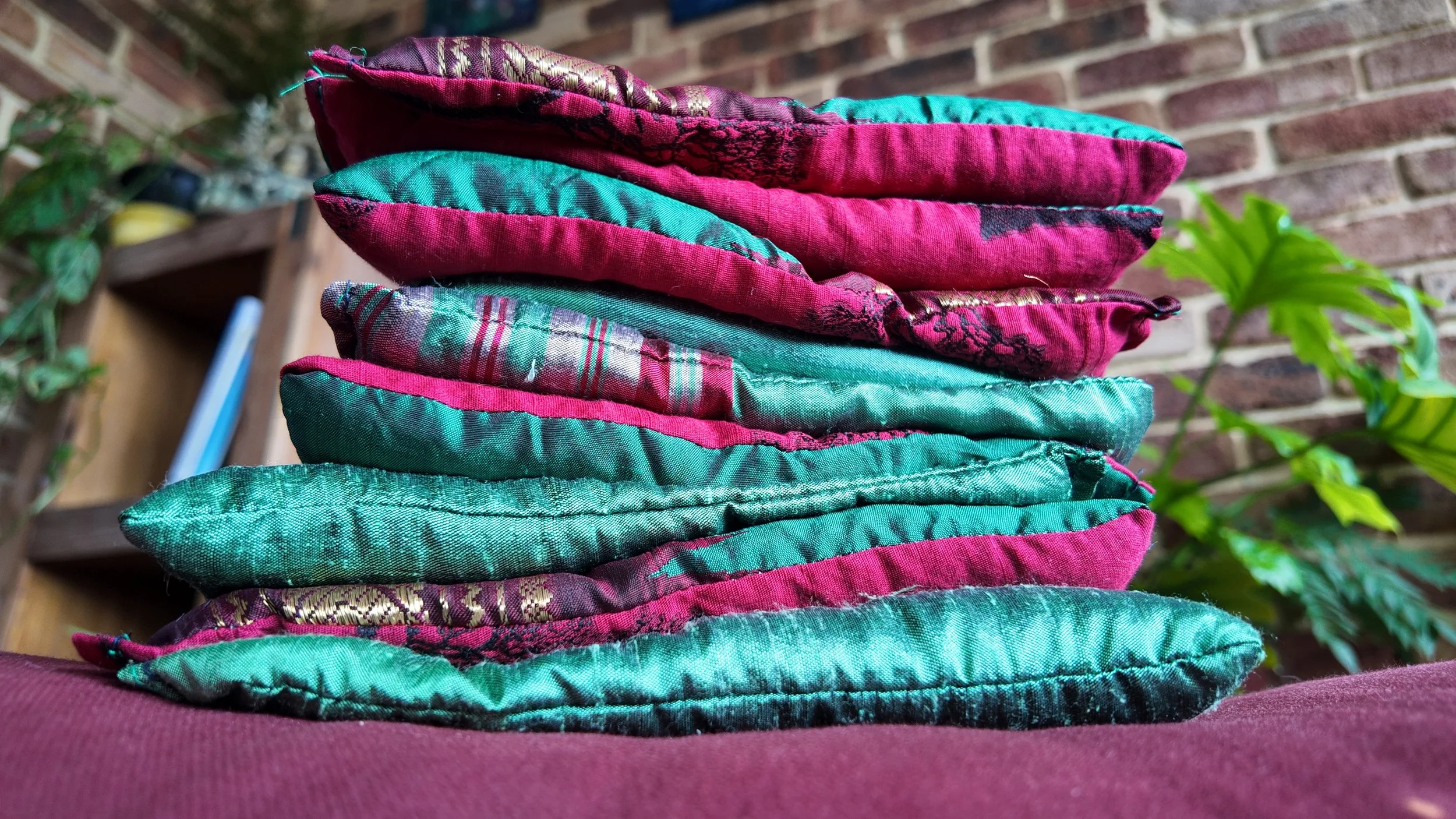
Eye pillows made with silk and filled with linseeds. The silk is from a sari my mum wore many years ago at a dinner in Pakistan with the Aga Khan.