

My Body Taught Me What Talk Therapy Could Not.
How I Learned About Slow Medicine.
In 2017, the wildfires that devastated Portugal tore through our little valley and destroyed everything we had built. Our home, retreat centre, business and livelihood. Years of work, of growth and community. Three outdoor kitchens with three gas bottles resulted in three explosions. Almost everything was gone in less than an hour.
What followed were the most harrowing years of my life. The shock of losing everything so suddenly and so completely was a level of trauma that I had not experienced before. It was confusing and did not resolve itself predictably. It was particularly annoying that the professionals I expected to understand, were unable or incapable of offering support.
The immensity of the traumatic experience sequestered itself in my body, leading to a nervous system that was on edge for years after. The tension and trauma eventually became a constriction in my throat and shoulders. It took me several years to even be able to identify these things let alone work with them.
About three years after the fire I truly acknowledged that I had developed PTSD, and I began to understand what it feels like to have been through something overwhelming and still not feel safe. I had become super reactive in a way I had never been before, very impatient with my children, lots of shouting and ironically zero tolerance for loud noises. My youngest children were 4 and 6 at the time of the fire. My eldest child age 12 went to the UK to live with her father three months after the fire, an extra layer of loss that I couldn’t even begin to process at the time. I couldn’t sleep, often waking every hour, or hour and a half, falling asleep dreams waking me up all night. Yoga nidra became my daily saviour practice.
I tried some conventional ways to find my peace again. Counselling, EMDR, six months of talk therapy. They each had their value, but none of it really touched the constant hum of nervous system activation and anxiety that had become my baseline. I moved away from the Portuguese countryside, off the land and relocated to the coast in, finding deep peace in being close to the ocean again, as I had been in my Australian childhood.
The fire lost us our livelihood, our beautiful little off grid retreat centre, where we hosted groups through late Spring to early Autumn, and small groups or glamping families around the peak season.
I had to scramble to find new employment in a foreign country with exceptionally low wages (Portugal’s minimum wage is the second lowest in the EU). Luckily I fell back on my teaching qualification, completed a TEFL qualification and taught English as a second language online for students in Hong Kong, Taiwan, China and Malaysia.
For the years after the fire I lived in a state of constant and unpleasant activation, hypervigilant, body braced, and disconnected from a sense of safety in my own body. Despite my years of yoga and meditation practice I felt completely helpless in finding a sense of normalcy again.
A car accident in 2020 left me with a badly fractured left femur, high up and into my hip socket. What followed was a 16 day nightmarish experience in the orthopaedic ward in Coimbra University Hospital that only compounded my existing ‘fire’ trauma. The ORIF surgery was performed without a general anaesthetic only a ‘left leg epidural’.
During my 7 day wait for surgery I had no idea it would be performed without a general anaesthetic, it is not common cultural practice for medical professionals to communicate effectively with patients in Portugal. Shortly after being wheeled into theatre three young and cheerful medical students informed me that no general anaesthetic would be administered, simply a numbing of the nerves, and they would make me ‘sleepy’. Not sleepy enough!
Orthopaedic surgery rates as the most violent and aggressive of surgeries. I had the pleasure of a grumpy, rude, small, brow furrowed surgeon who did not even introduce himself to me. I was awake and aware as my leg was opened, listening to the grinding and sawing along with the cursing and swearing as the wrong size rods were not able to be shoved into the marrow of my femur and femur head. Eventually, correct size was found, and shoved, some pins attached, and finally I heard from the cheery medical students, that the ordeal was almost over.
I spent 16 days in hospital without the sort of pain relief we would expect in an Australian or British hospital, and being manhandled by very unsympathetic nurses. I have given birth to three children, two of them in Portugal under equally unforgiving conditions…… but during these 16 days I experienced levels of physical pain that I have never experienced before.
It really made me realise the traumatic impact of medical procedures and interventions, my own ability to cope and ‘put on a brave face’. Ultimately of course, this experience added more layers for me to untangle when I was able to.
Luckily my years of yoga practice, and my interest in somatic movement and therapeutic yoga allowed me to heal myself once I got home. These were the covid years so even getting follow up x-rays was a challenge. I used my knowledge and would spend about an hour every afternoon, mostly with my legs up the wall, but slow gentle movement, breathing, meditation practice, and daily yoga nidra helped me to recover and learn to walk again. It took a lot of patience, slow medicine.
After the fire I was thrown into the chaos of relentless Portuguese bureaucracy, and exhausting battles with lawyers in an archaic country and language that was not my own. A long story ….. in June 2017 the Portuguese government promised to rebuild homes lost in fires because the fires were so bad, in October 2017 there was another wave of fires and this was when we lost our place.
The government had also offered tax deals to private businesses to fund the rebuild of homes (I later found out). We were very lucky to have our home rebuilt by a private business, which meant it wasn’t a standard generic government rebuild, it was rebuilt more or less as it was before the fire. A house was built, but not without challenge, difficulty and lots of complaints about the costs involved. The funding came from an engineering company based in Lisboa, who despite constructing huge buildings in Brazil and Portugal, were not familiar with rebuilding rural stone structures. As a traditional stone building it requires careful, environmentally aware reconstruction using lime and breathable materials to prevent dampness and mould. Instead there was lots of concrete and bad plumbing. It was a roof over our heads nevertheless and after 9 months we could finally vacate our kind neighbours holiday apartment.
After two years of living back on the land, feeling such a deep sadness for what had been lost, and watching the eucalyptus regrow relentlessly. Portugal’s eucalyptus monoculture is a cash crop, planted for the cellulose industry, beloved by the landowners for its fast returns and despised by everyone who understands fire and the damage the eucalyptus does to the indigenous forest that once covered the land.
The same trees that had turned our valley into a tinderbox were coming back, because nothing in the land management had really changed, despite new government laws around replanting and maintenance, nothing had been learned, and nobody in authority seemed particularly troubled by any of it.
The imported Blue Gum grows fast and has a 8-9 year turn over, as opposed to the Maritime Pine trees that were previously grown in rural Portugal, which could be harvested after 30-35 years of growth. It is understandable in a country of poverty and subsistence farming that landowners choose to grow this crop, unfortunately it is mostly unmanaged, left to grow wild, and easily harvested after fire. It causes lots of damage and destruction for most, and earnings for the few wealthy landowners in the small Portuguese villages This happens almost every summer in Portugal.
The sickening feeling that we lost our home to the toilet paper industry had set in and all I wanted to do was get out. The same trees that burned our home to the ground were replanted to make more toilet paper. This lucrative cellulose industry is backed by powerful lobbying making any meaningful land management reform unlikely.
‘Renova is one of the major Portuguese pulp and paper companies whose products reach consumers as toilet paper and paper towels, and whose industry depends on eucalyptus plantations in the very regions devastated by the 2017 fires. Six years after the 2017 Pedrógão Grande fire, a mantle of eucalyptus already covers much of the mountainous landscape again, plantations rather than forests, grown exclusively for pulp.’
My initial attempts to put our property on the market were met with long silence and delays from the local town council. I was eventually told that I had signed an agreement in 2018 and that I was not allowed to sell the property. I had no memory of signing an agreement, asked lawyers to get a copy of the agreement and received more silence, no answers and more delays. Finally after five years, four lawyers, a meeting with the new mayor of the rural town council, and one dramatic meltdown on my part, the paperwork was eventually completed and the property sale was underway.
I have now returned to northern NSW, my home, and am able to joke about having Portugal Traumatic Stress Disorder. I have also dived deep into somatic movement practices, therapeutic yoga and a somatic therapy modality, Embodied Processing. These practices have truly supported my journey through recovery, and consolidated almost 30 years of yoga and movement practice in a more focussed way.
It was by happy search engine typo accident that I discovered Embodied Processing (EP), and from the beginning it felt accessible, coherent, and meaningful. I felt like it found me at exactly the right time. As I moved through the months of learning and training, practice exchange sessions with colleagues, and eventually embarked on my own regular sessions, I started to notice I felt lighter, challenges felt more manageable, and it became easier for me to do the processing myself.
EP became lived understanding of finding my way back to myself and understanding my own nervous system. It became a slow medicine experience for me. I now feel stable, contained and balanced, able to hold the stresses of everyday life. My intention is that I am able to bring that experience into every session with clients.
EP is a safe, integrative modality, which draws on both modern neuroscience and ancient wisdom traditions. It truly honours the understanding that healing is embodied, relational, and spiritual. The modality was developed by Matt Kay and Ryan Hassan at The Centre for Healing in Melbourne. It draws from a rich lineage of somatic pioneers including Peter Levine’s Somatic Experiencing, the NeuroAffective Relational Model (NARM), Gabor Maté’s trauma work, and the Hakomi Method.
At its heart, EP continues the important understanding first brought forward by therapists like Wilhelm Reich and Alexander Lowen: that emotional trauma and stress don’t just live in the mind, they become held in the body as tension, posture, and nervous system patterns. Over the past two decades, neuroscience has been validating what somatic practitioners have known for a long time, that trauma is not just a story in the mind, it’s also a physiological state held in the body. For most of the twentieth century, therapy focused mainly on our thoughts and narratives, involving a lot of talking about it all. Traditional talk therapies have helped lots of people, but it doesn’t work for everyone. Somatic therapy offers a different way of processing our difficult experiences, based on the fact that while the body may hold the trauma, it also offers us the way through.
What we now understand is that overwhelming events launch our nervous system into the protective responses of fight, flight, freeze, or fawn. While these responses are the intelligent function of the nervous system, and have their purpose, problems arise when these responses don’t have the opportunity to complete. The body can get stuck on alert. Stress hormones, muscle tension, breath patterns, and posture can all hold the imprint of those experiences long after the mind has processed the story.
The strength of Embodied Processing and other therapeutic somatic modalities is that they work directly with the body, and allow it to complete unfinished survival responses, release undigested emotional charge and work gently through past trauma.
What Happens in an Embodied Processing Session?
Sessions begin with a gentle check-in, we talk, take a moment to arrive and be heard. You can bring whatever is present into the space. Trauma informed work encourages a space where everything is welcome. We work at your pace, with whatever you bring, and whatever choices you make. We explore the things you want to explore. It is slow medicine.
We always begin with grounding and a mindfulness-based body scan, settling the nervous system and building a felt sense of resource before any deeper work begins. This supports you to stay safe and grounded throughout the session, and have a place to return to if you start to feel over activated.
The heart of the session involves turning attention inward to bring curiosity to something we have chosen as a starting place, or just noticing sensation in the body in this present moment. We take a look at what is arising and we allow it to be met rather than managed. Using techniques like pendulation, titration, questioning, distancing and merging, we work gently with what comes up, moving towards and away from activation in a way that stays within your window of tolerance. Breath and movement might be invited in as tools for exploration as a natural way of following what the body is already trying to process. Talking or re-telling the stories is not necessary, rather we turn back to sensation in the body with curiosity and allow it move and shift in its own time. The beauty of Embodied Processing is it’s careful, gentle approach.
Integration is experienced differently in every session, or series of sessions. It might involve progression of visualisation or sensation, gentle reframing, words or memories that want to be acknowledged. There is no fixed path. Each session follows you. Integration often happens in an organic way, with a certain amount of trust in the process. Slow Medicine takes it’s own time.
We close by returning to resource, grounding, and breathing, a settling, and a moment to reflect and consolidate what has arisen. We make a gentle acknowledgement of moments of insight or shifts that emerged along the way. By gently tracking sensation, building regulation, and allowing the body’s own intelligence to lead the process, EP works to create the conditions in which change becomes possible.
Sometimes after a somatic session, we can feel tired, vulnerable, or a little spaced out. This is a normal, sometimes referred to as ‘the healing hangover,’ and is often positive sign that the nervous system has been engaged in some processing, maybe some discharge or release, and it may need a little time to rest and integrate.
*Mancini, D. (2023, December 5). Portugal: Wildfires and the eucalyptus curse. European Data Journalism Network.
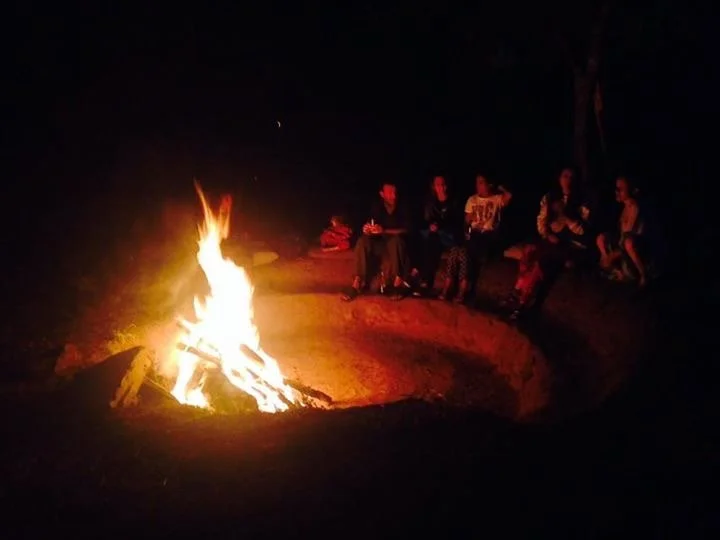
The Irony of Fire.
At the end of every yoga retreat week in Portugal, we used to light a fire in our fire pit, and light our wood burning hot tub for the guests. It was always a joyous way to end each week.